Our News & Blogs
Crop Diversity and Seasonal Cropping Pattern of Nayakrishi Farmers in Delduar, Tangail

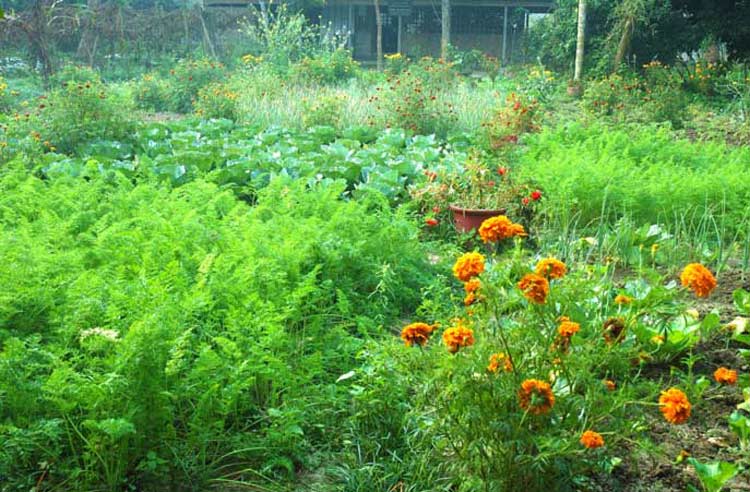
Delduar Upazila of Tangail district is rich in natural biodiversity. Farmers cultivate a wide range of crops throughout the year by matching crop varieties with land type, season, and local ecological conditions. Crops are grown on plains, high lands, medium-high lands, low lands, and homestead areas, ensuring year-round agricultural production.
Both men and women contribute significantly to agricultural production. However, women play the central role in preserving agricultural biodiversity by collecting, drying, cleaning, storing, and conserving seeds. The continuity of local seed wealth largely depends on their knowledge and practice.
Nayakrishi farmers primarily use organic manure and follow seasonal crop rotation while maintaining their own seed stocks and exchanging seeds through Nayakrishi Seed Akhras.
Seasonal Cropping Pattern
Nayakrishi farmers cultivate crops according to three major agricultural seasons:
- Rabi Season
- Kharif-I Season
- Kharif-II Season
Besides seasonal crops, several vegetables and fruit crops are cultivated throughout the year.
Crops in the Field During Late March
During late March, Rabi crops are nearing harvest while sowing of Kharif-I crops has already begun in the following villages:
- Nanduria
- Gorashin
- Binduria
- Nallapara
- Goziyabari (Atia Union)
- Mushuria (Elashin Union)
Major Rabi Season Crops
The important Rabi crops include:
- Wheat
- Grass pea
- Barley
- Water gourd
- Common bean (Shim)
- Sweet potato
- Onion
- Garlic
At this period:
- Wheat, barley and grass pea are almost ready for harvest.
- Onion, garlic, mustard, lentil and tomato have already been harvested.
- Common bean remains in the homestead gardens at the mature fruit stage.
Major Kharif-I Crops
The principal crops grown during Kharif-I are:
- Sweet gourd
- Brinjal
- Bitter gourd
- Snake gourd
- Chili
- Little cucumber
- Red amaranth
- Indian spinach
- Sponge gourd
- Ash gourd
- Arum
- Okra
- Aus rice
- Jute
Crops Available Throughout the Year
Several crops remain available throughout the year, especially around homesteads and nearby high lands.
These include:
- Brinjal
- Papaya
- Banana
- Lemon
Banana Cultivation
Farmers grow several local banana varieties including:
- Sobri Kola
- Sagar Kola
- Chapa Kola
- Plantain
Banana is generally planted during the Bangla month of Chaitra (March–April).
To maximize land use, farmers cultivate companion crops between banana rows, such as:
- Brinjal
- Chili
- Stem amaranth
- Sweet gourd
- Okra
Many banana orchards are currently in the fruit-bearing stage, and harvesting has already begun.
Lemon Cultivation
Lemon trees are grown mainly on high land.
Common local varieties include:
- Elachi
- Colombo
At present the trees are flowering and fruiting, with the main harvest expected within 20–25 days.
Climber Vegetables Around Homesteads
Most farming households cultivate climbing vegetables around their homes, including:
- Water gourd
- Sweet gourd
- Common bean (Shim)
- Ash gourd
- Sponge gourd
- Indian spinach
- Snake gourd
- Ridge gourd
Seeds are usually sown near the house and supported using bamboo poles, tree branches, or even rooftops.
Community Seed Conservation
One of the unique characteristics of Nayakrishi farming is community seed conservation.
Farmers:
- Preserve seeds in their own household seed stores.
- Deposit a portion of their seeds in the Nayakrishi Seed Akhra.
- Collect seeds from the Seed Akhra during shortages.
- Multiply quality seeds for both household use and additional income.
This decentralized seed system strengthens local biodiversity and reduces dependence on commercial seed markets.
Sowing and Harvesting Calendar
| Crop | Time of Sowing / Transplanting | Time of Harvest |
|---|---|---|
| Wheat | Late October – Late November | Mid March – Early April |
| Grass Pea | Late October | Mid – Late March |
| Barley | Late October – Mid November | Mid – Late March |
| Sweet Potato | Late October – Mid November | Mid April – Mid May |
| Brinjal | September – October | February – April |
| Snake Gourd | January – February | April – June |
| Onion | October – November | March – April |
| Garlic | October – November | March – April |
| Common Bean (Shim) | July – August | October – March |
| Sweet Gourd | November | January – April |
| Water Gourd | August | November – April |
| Stem Amaranth | February | March – April |
| Little Cucumber | October | January – April |
| Red Amaranth | September | November – January |
| Bitter Gourd | October | February – May |
| Indian Spinach | February | March – August |
| Sponge Gourd | February – March | April – October |
| Ash Gourd | February – March | April – October |
| Okra | February – March | April – October |
| Jute | March – April | July – August |
| Arum | February – March | April – July |
Benefits of Seasonal Cropping
Season-based crop cultivation provides multiple benefits to Nayakrishi farmers.
- Ensures year-round food production.
- Improves household food security.
- Maintains crop diversity.
- Conserves indigenous seed varieties.
- Generates cash income through seed multiplication.
- Surplus crops are sold in local markets, Shashya Sundar (Tangail) and Shashya Prabartana (Dhaka).
- Reduces dependence on external agricultural inputs.
Conclusion
The Nayakrishi farming system of Delduar demonstrates how ecological knowledge, seasonal crop planning, organic farming, and community seed conservation can sustain agricultural biodiversity while improving rural livelihoods. Women’s leadership in seed preservation, together with farmers’ traditional knowledge, continues to strengthen food sovereignty and ecological resilience in the region.